
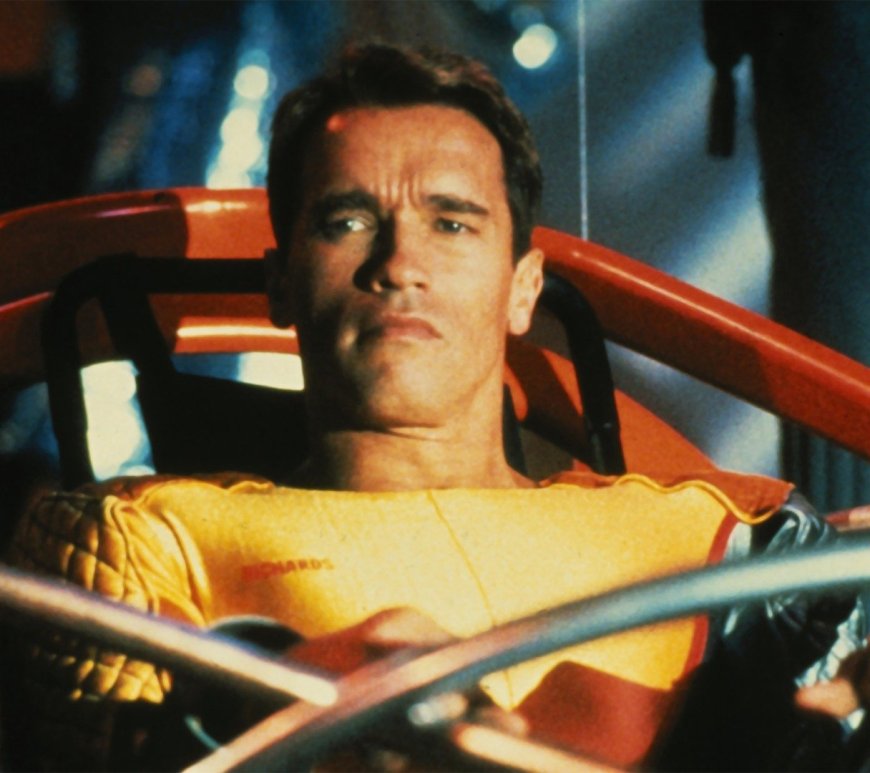
When it comes to adaptations, Stephen King himself has mixed opinions on how some of his works have made it to the big screen. One such film he has less than charitable views on is the original adaptation of The Running Man, a downbeat King writing as Richard Bachman book that was brought to screen as a bombastic crowd pleaser starring Arnold Schwarzenegger. So yeah, the original 80s adaptation of The Running Man is not exactly a faithful recreation of the text. It is, however, a fun shot of Arnold in his prime, at a time when action films were bright and colorful, filled with bloody squibs and bad one-liners, and were a guaranteed good time at the movies.
This film’s version of Ben Richards is a far cry from the character in the novel. This Richards is a police captain who, after refusing to fire on an unarmed crowd, is subsequently framed for the massacre after his subordinates carry out the orders. Used as a scapegoat by the totalitarian government, Ben Richards begins the story in prison, seeking not only to prove his own innocence but expose his government for ordering the killings. When he breaks out of prison, it creates a media sensation. And that’s just what the film’s villain, Killian, wants.
After Ben is recaptured, Killian believes having him participate in the show will be a sensation for the fascist government and the his own success, and so, with the nation watching, Ben and his fellow prison escapees are put into a obstacle coarse style game zone as ‘runners,’ where they are subsequently pursued by ‘stalkers,’ psychos in WWE cosplay who try to kill them on live television. Escape the stalkers, you earn your freedom. Don’t? Well, there aren’t any opportunities for do-overs.

Like the Kubrick adaptation of The Shining, The Running Man captured the plot of the book with its characters and general premise, but made some significant changes. For one, in this version of The Running Man, unlike both the book and the new film, the entire show is confined to an in-studio arena rather than having the contestants trying to escape their killers out in the world. This lacks the gritty feel of the novel, but it is also one of the first things that shows that while this may not be a good adaptation of the novel, it is nevertheless a fun movie.
The Running Man turns the arena into a vibrant, surreal landscape with high contrast colors and strange shapes. The city is something like we’d seen on American Gladiator, albeit with far more blood. In some ways, 1987’s The Running Man is a precursor to Total Recall, Arnold’s sci-fi classic from three years later. The world of The Running Man has a similar low-fi aesthetic of a not-quite-distant future. Let’s just say this isn’t the world of Children of Men. And that bright, vibrant feel is one of the first indicators of the biggest change between this and the novel.
1987’s The Running Man is an amazingly fun movie.
In the 1980s, after the success of The Terminator, Arnold was a highly sought-after actor, appearing in numerous cult and action classics that helped define several genre traits, from over-the-top violence to catch phrases as cringeworthy as they were catchy. One of my favorite movies from the brawney man is Commando, his silly and over-the-top follow-up to The Terminator. Now, Commando isn’t exactly good, but it is amazing. While I wouldn’t go so far as to say The Running Man is as outlandish and fun as Commando, it does share a lot of the same DNA.
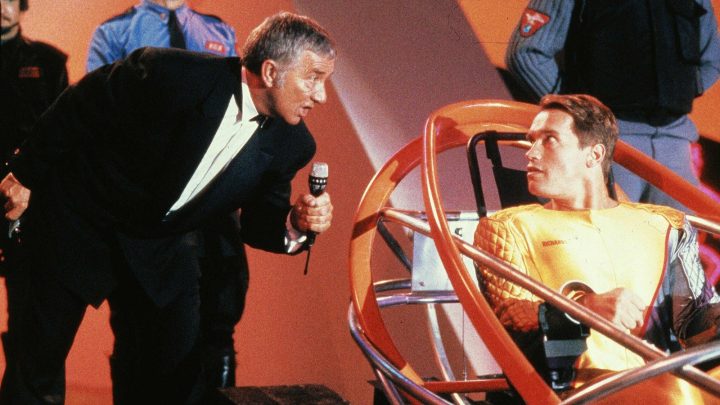
There is a lot to love about this adaptation of The Running Man. Arnold, as usual, crafts a lead character we root for, and seeing him dispatch the stalkers in ways that would make Jason Voorhees blush is always a joy to watch. The supporting cast is excellent, with María Conchita Alonso (Predator 2, Vampire’s Kiss) as Amber Mendez, holding her own as Arnold’s partner in survival. Other sci-fi genre regulars make appearances in the film, such as the always wonderful Yaphet Kotto (Alien) and Jesse Ventura (Predator). But it’s Richard Dawson as Running Man host Damon Killian who really steals the show. Think Jerry Springer meets any one of history’s great monsters, and you are left with a murdering madman who delights in watching other human beings get torn to shreds, and he’ll make you love it, too.
While on this battlefield, Richards tries to make it through with his friends and allies from throughout the film, such as fellow inmates and the always excellent Alonso. The sequences are thrilling, each with its own style. The cold tones of the battle against Subzero are in sharp contrast to the fiery duel against Buzzsaw, but none of this would matter if the mission of the hero didn’t matter. In this regard, this may be where the story differs most from the original King novel. In the original novel, Richards is a down-on-his-luck working man looking to get an easy payout to support his family. Arnold’s Richards is more like the classic Hitchcockian wrong man, a man framed for a crime he didn’t commit and is now setting out to prove his innocence. Being the type of movie this is, we can surmise that our Austrian hero will carry the day. The question is how we get there.
This is where the confined setting works to the movie’s advantage. Richards and the rest of the cast are trapped inside the arena, and Killian has no intention of letting them go. It’s like the plot of Tron. You keep them in the games until they die playing. And Killian is making sure they don’t leave. In an oddly prophetic moment, Killian even stages it to make it seem that our two leads are killed graphically in front of the audience, using what could only be described as a deepfake to accomplish the deed, superimposing Ben’s face over the face of a crew member who wasn’t expecting to be killed on camera. Another example of past science fiction managing to predict the future, even if not absolutely accurate.
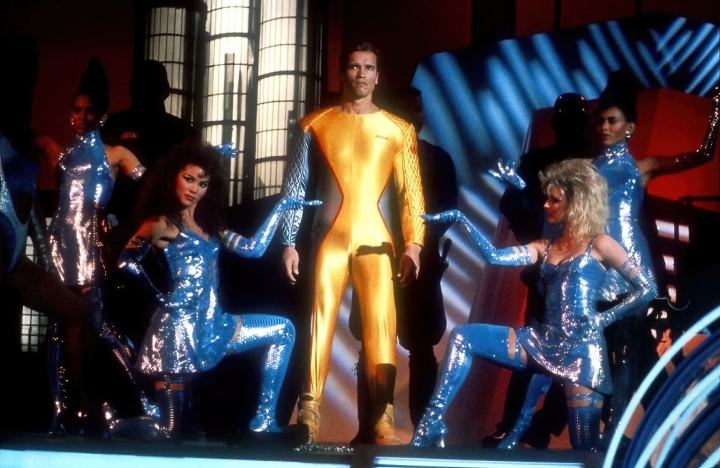
The Running Man makes the most of its colorful setting, as well as its stalkers. Ben Richards has to contend with numerous killers, each with their own themed way of dispatching a contestant. Fireball likes to burn them. Subzero likes to freeze them. Buzzsaw likes to cut them up, and the list goes on. It’s these fights where the movie really shines, pitting Arnold against the next killer in a themed battle arena. For example, Subzero’s theme is ice. So the fight with him takes place in a freezing skating rink. Richards works through each arena and each killer one by one in a series of vibrant and violent set pieces that are sure to satisfy the bloodlust of most audiences. These fights, which feel like athletic competitions gone wrong, are easily the most fun and memorable part of the movie.
Measure The Running Man as a King movie, and you will inevitably come up short. So my advice is don’t look at it as a King movie. This version of The Running Man is better remembered as a fun example of the 80s action film. It has the cheesy over-the-top performances of Commando with the imaginative worldbuilding of Total Recall. When looking for a solid King adaptation, that is obviously not what most people will buy their tickets for. But if you’re looking for a good Arnold thriller? This movie remains as solid an example as any. The problem is, I can’t figure out if it makes a better double feature with Commando or Total Recall. The movie, of course, contains several examples of Arnie’s cheesy catch phrases, and one of them sums up my feelings whenever I give this 87 dystopian chase flick a rewatch:
“Well, that hit the spot.”
Want to know the context for this one-liner? Guess you’ll have to watch the movie.